


Introduction
Have you ever found your “dream scholarship” and started applying with excitement—only to realize halfway through that you’re not eligible because of one small requirement you missed? Or maybe you were rejected and kept wondering, “Why?” even though your academic record is strong.
Often, the issue isn’t your capability—it’s how you read the scholarship requirements. A scholarship announcement is not something you skim quickly; it’s a “map” that tells you who will be accepted and how the selection committee evaluates applications.
At Forsati, we summarize scholarships for you—but we also want to teach you how to “catch the opportunity” on your own. Here is a practical guide to reading any scholarship and decoding it in 4 clear steps.
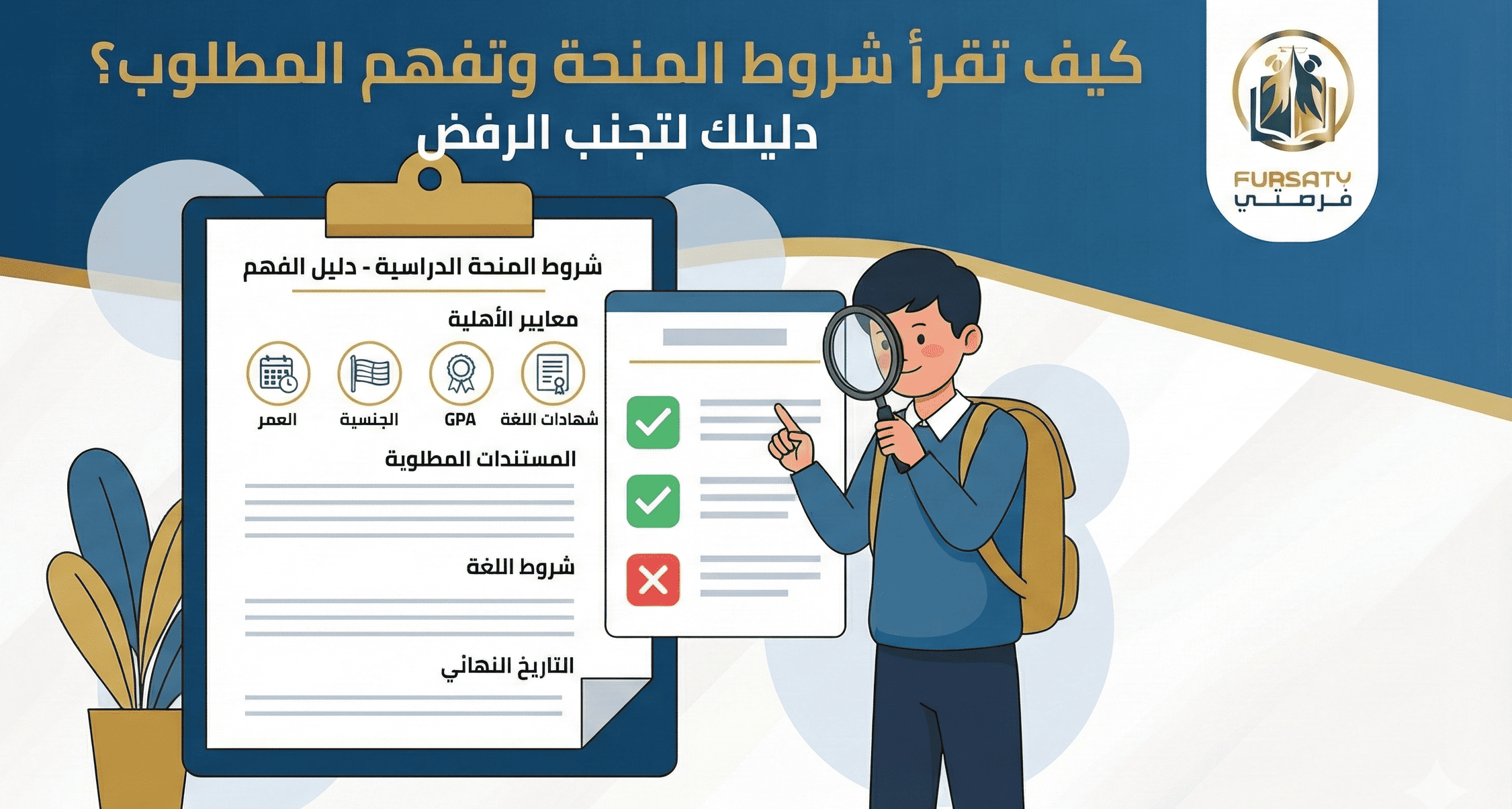
1) Start with the Eligibility Criteria (First!)
Before reading about benefits or the monthly stipend, go straight to:
Who can apply / Eligibility / Eligibility Criteria
This is the first filter. Focus on three key items:
-
Age: Is there an upper age limit (e.g., under 30), or no age condition?
-
Nationality: Is your country (Yemen, Egypt, Syria, etc.) eligible to apply?
-
GPA / Minimum grade: Do they require a minimum GPA or percentage (e.g., 75% and above)?
Golden tip:
If you fail one essential eligibility condition, your application will often be rejected automatically. It’s better to move on quickly and search for a scholarship that matches you.
2) Separate “Required” from “Preferred”
This is where many students lose opportunities: they assume everything written is mandatory.
Most scholarships list two types of requirements:
Required (Must/Required)
Examples: bachelor’s degree, passport, graduation year…
Missing any required item = immediate rejection.
Preferred (Preferred / Advantage / Nice to have)
Examples: volunteering experience, extra courses, basic knowledge of the local language…
Missing preferred items does not mean rejection, but having them can improve your chances.
Bottom line:
Apply even if you don’t have the preferred items—but never ignore a required condition.
3) Read Language Requirements Carefully (and Smartly)
Language is the most common obstacle, but it can be more flexible than you think—if you read it properly.
Ask yourself:
-
Do they require an international test only (IELTS / TOEFL)?
-
Do they accept alternatives like an English Proficiency Letter from your university?
-
Does the scholarship offer a preparatory language year (common in some Turkish/Russian programs)?
Understanding the language condition can open a door you thought was closed.
4) Check the Required Documents (The Checklist)—Don’t Delay
Right after eligibility, go to:
Documents required / Required documents / Checklist
Then watch out for these points:
-
Do your documents need translation and official legalization? (This may take time and money.)
-
Do they need recommendation letters in a specific format or via an official form?
-
Do they require a motivation letter or an essay?
Start early with time-consuming tasks like recommendations, passport renewal, translations, and legalization—don’t wait until the last week.
Today’s 5-Minute Action Step
Open one scholarship you want to apply for, and write three requirements from it. Next to each requirement, write:
-
Why did they include it?
-
What is the strongest evidence I have to prove it?
This simple exercise helps you read like a selection committee—not like a rushed applicant.
Conclusion
Reading scholarship requirements smartly is half the path to acceptance. The other half is preparing a clear, professional application that reflects your strengths. Don’t let complex terms scare you—at Forsati, we’re here to simplify things for you.
Have you checked the requirements and confirmed you’re eligible?
Explore the Scholarships Section on Forsati and choose your next destination. And if any requirement is unclear, feel free to ask our team for guidance and review.